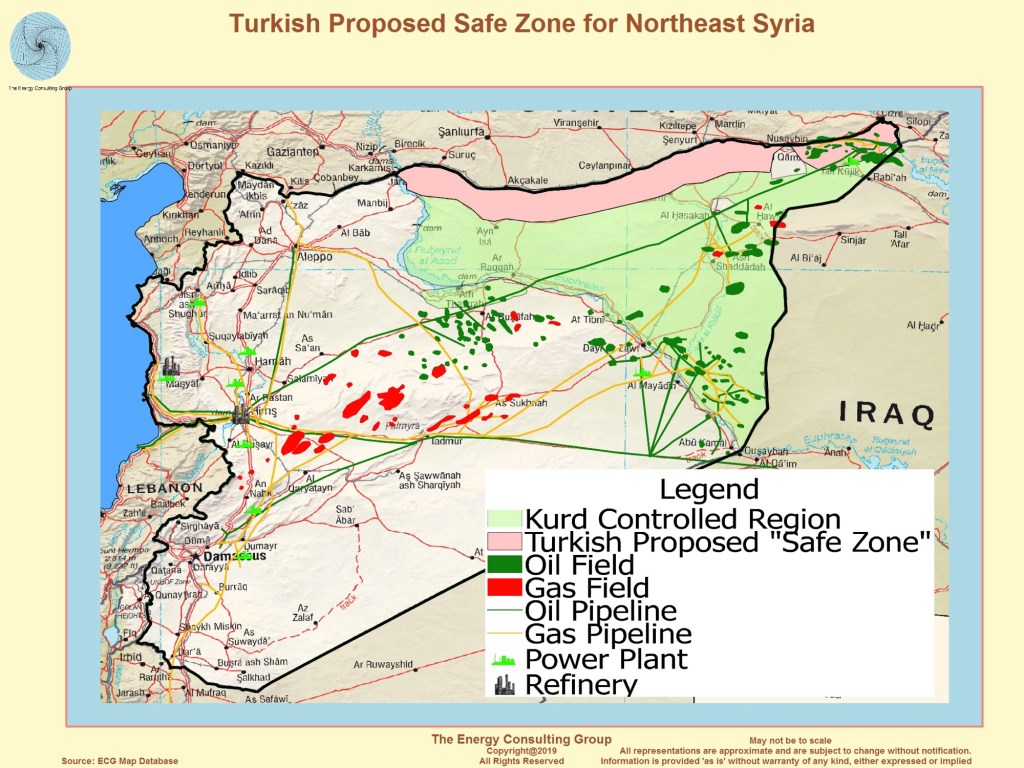
Kurds region capacity
1. Introduction
The Syrian Kurds—particularly the Syrian Democratic Forces (SDF) and the Autonomous Administration of North and Northeast Syria—are among the key political, security, and economic actors in the country. An agreement between the central government in Damascus and the Kurds could not only prevent the continuation of geographical fragmentation but also strengthen and stabilize governance capacity.
2. Political Dimension: Preventing Fragmentation and Governance Models
The Iraqi federalism model, which has granted the Kurdistan Region of Iraq a prominent role in controlling fossil fuel resources, is supported by Europe, the United States, Arab states, and Israel. Only Turkey, due to geopolitical concerns and fears of strengthening its own Kurdish population’s aspirations, strongly opposes this model. An agreement with the Kurds could reinforce national cohesion and prevent the continuation of parallel governance structures.
3. Geo-economic Dimension: Oil and Gas Resources of Syrian Kurdistan
Syrian Kurdistan hosts most of the country’s oil and gas resources, especially in Al-Hasakah province (Rmeilan and Sweidiya fields) and Deir ez-Zor (Al-Omar and Al-Shaddadi fields). According to pre-war estimates, Syria had about 2.5 billion barrels of proven oil reserves, with the majority located in the northeast【BP, 2011】. Before 2011, this region produced around 380,000 to 400,000 barrels of crude oil per day, most of it from fields currently under Kurdish control【EIA, 2010】. Natural gas is also present, albeit in smaller quantities, but with infrastructure development, it could meet domestic demand and enable exports.
4. Geographical Position and Energy Export Routes
Proximity to the borders of Iraq and Turkey provides a prime location for connecting to pipelines and export routes. The region sits at the crossroads of potential future pipeline routes that could connect to Mediterranean ports or Turkey. The Kurdistan Region of Iraq’s experience with the Ceyhan pipeline illustrates how such infrastructure can become a significant source of revenue.
5. Security and Geopolitical Considerations
Cooperation between Damascus and the Kurds could strengthen security along the borders with Turkey and Iraq, while preventing the resurgence of extremist groups like ISIS【ICG, 2020】
6. Conclusion
Reaching an agreement with the Syrian Kurds is a strategic necessity for political, security, and economic reasons. Such an agreement could:
Prevent territorial fragmentation; Activate Syria’s economic and export potential; Reduce dependence on foreign powers.
Point:
Without such an agreement, the vast energy potential of Syrian Kurdistan may remain untapped or fall under the control of external actors, seriously hindering the country’s reconstruction and stabilization.
References
BP Statistical Review of World Energy, 2011. U.S. Energy Information Administration (EIA), Syria Country Analysis Brief, 2010. International Crisis Group (ICG), Avoiding a Return to War in Northeast Syria, 2020. Chatham House, Syria’s Oil and Gas: Untapped Potential in the Northeast, 2019. Carnegie Middle East Center, The Politics of Syrian Kurdistan, 2021.
 Site Title
Leave a comment